Checks worth making before you call
A number of apparent failures have simple explanations, and an owner may rule them out in a few minutes.
- Power. Confirm that the unit is plugged in and that its outlet is live. Outlets in garage ceilings are commonly protected by a ground-fault device elsewhere in the garage, which may have tripped.
- The lock function. Many wall controls have a lock or vacation setting that disables the remotes. It is easily engaged by accident.
- The sensors. Each of the two photoelectric units near the floor has an indicator light. Both should be steady. A flashing or unlit indicator means the beam is obstructed or the units are out of line.
- The remote. If the wall control works and the remote does not, replace its battery.
- The release. If the motor runs and the door does not move, the trolley may have been disengaged. Operating the unit through a full cycle will usually re-engage it.
If none of these resolves the matter, the fault needs proper diagnosis.
Reading the symptoms
| What is observed | The likely explanation |
|---|---|
| The motor hums and the door does not move | Frequently a broken door spring. Otherwise a failed capacitor or a stripped drive gear. |
| The door closes, then immediately reopens | Sensors obstructed or misaligned, or the close limit set beyond the floor |
| The door reverses partway down | Binding in the track, or a door out of balance, registering as an obstruction |
| The door stops short of closing or opening fully | Travel limits have drifted |
| The wall control works, the remotes do not | Batteries, programming, or radio interference, sometimes from retrofit light bulbs |
| The lights flash and nothing else happens | A diagnostic code. The number of flashes identifies the fault. |
| The motor runs with a grinding sound and the door stays put | A worn drive gear within the housing |
| The door operates of its own accord | A stuck button on a remote or keypad, or damaged control wiring |
| Operation is slow or labored in cold weather | Stiffened lubricant and a door requiring more force than the setting allows |
The door is examined first
This is the principle on which sound opener repair depends. We disconnect the operator and raise the door by hand. A door in proper balance lifts easily and stays where it is put. A door that is heavy, that sticks, or that hangs unevenly has been imposing loads on the operator that it was never designed to bear.
To repair the operator alone in such a case is to treat the symptom. The new gear or board will fail as the old one did. We therefore correct the door, as described under garage door repair, and then attend to the operator.
To repair the operator alone, when the door is at fault, is to treat the symptom.
The components we repair
Photoelectric sensors. Realigned, rewired, or replaced. The low-voltage wire that connects them runs along the wall near the floor, where it is vulnerable to garden tools, stored goods, and mice.
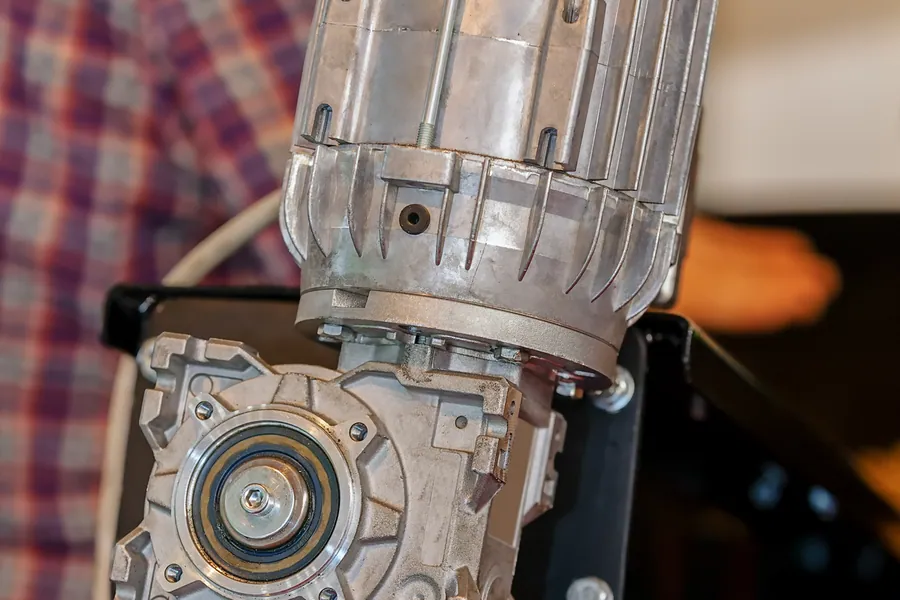
Drive gears. On many chain- and belt-drive units, a nylon gear transmits the motor’s effort to the drive. It is designed as the sacrificial part, and when it wears the motor runs freely while the door stands still. Replacing the gear assembly restores the unit.
Circuit boards. The control board is sensitive to electrical surges. Boards for current and recent models can be replaced. We recommend a surge protector at the outlet thereafter.
Capacitors. A motor that hums and will not start may need only this small component.
Belts, chains, and trolleys. Chains are tensioned. Belts and worn trolleys are replaced.
Limit and force settings. These drift with time and with the seasons. A force setting raised too high defeats the purpose of the safety reversal and should be corrected.
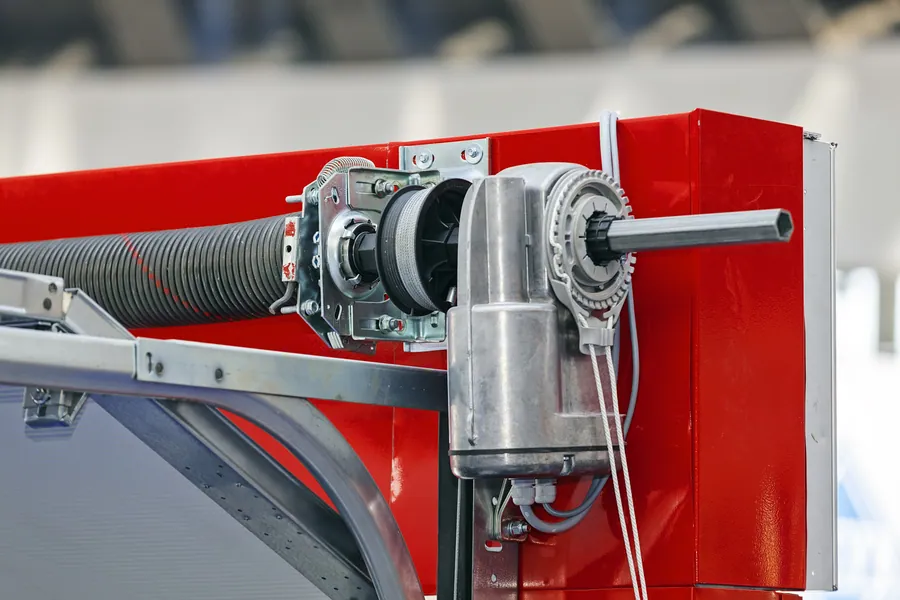
Wall-mounted operators. Their faults differ somewhat: cable tension monitors, position sensing, and the collar that couples the unit to the shaft.
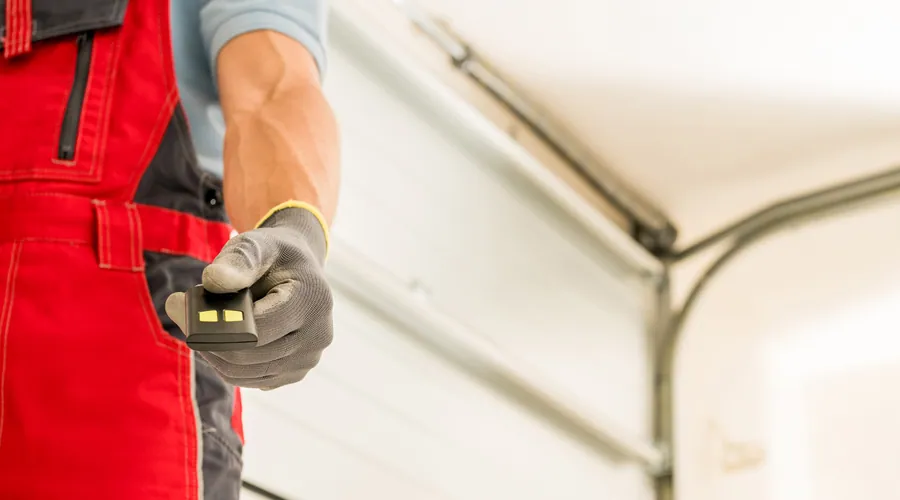
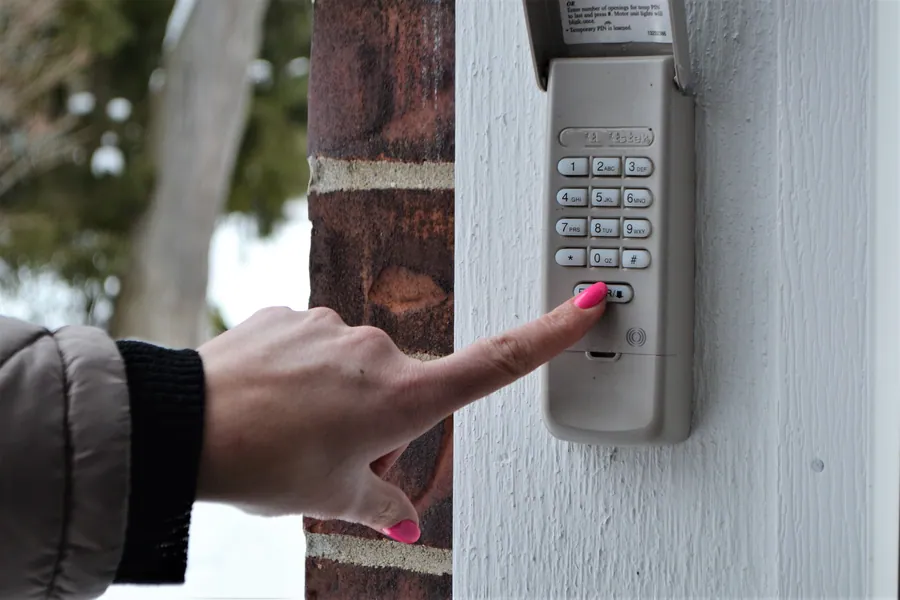
Controls. Wall stations, remotes, and keypads are reprogrammed or replaced. For a newly purchased house, we suggest clearing the operator’s memory entirely so that no earlier remote will work.