The principle
Every door in a working building is a compromise between access and separation. When it is open, people and vehicles pass freely, and so do heat, cold, dust, noise, insects, and fumes. When it is closed, the two sides are separate and nothing passes.
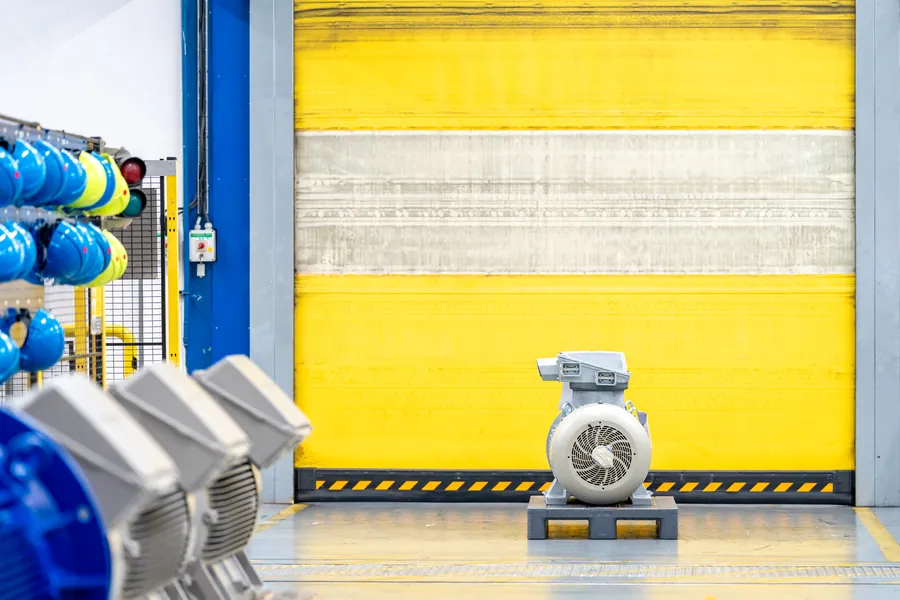
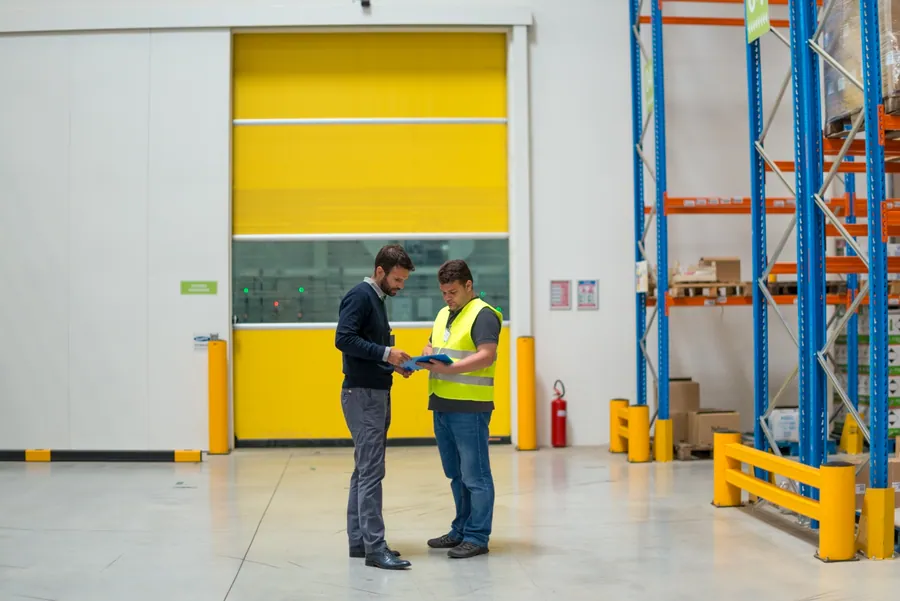
With a slow door, staff resolve the compromise in the obvious way. They leave it open. A high-speed door alters the calculation. It opens fast enough that a forklift driver need not slow down, and closes again automatically within a second or two of the vehicle clearing the opening. The doorway is shut for all but a few seconds of each passage.
Opening speeds vary by type and size. Figures between about thirty and one hundred inches per second are typical, and the fastest doors exceed that. Closing is generally somewhat slower, for safety.
Where they are used
- Between heated and unheated space A warehouse and its dock, a workshop and a cold store, a plant and an outdoor yard.
- Coolers and freezers Where each second of opening admits warm, moist air that must be removed again by refrigeration.
- Food and beverage production To separate processes, control temperature, and exclude pests and airborne contamination.
- Clean and controlled areas Where pressure and air quality must be maintained between rooms.
- Wash bays and wet processes To contain spray and humidity.
- Manufacturing To contain noise, dust, and fumes at their source.
- Parking structures Where a door must cycle for every vehicle without causing a queue.
- Exterior openings with heavy traffic As the working door inside a conventional security door.
Hartland’s business parks hold a good number of light manufacturers, distributors, and food-related businesses to which several of these apply.
The main types
Fabric roll-up doors
A curtain of reinforced vinyl or similar material winds onto a roller at the head of the opening and runs in guides at each side. Clear vision panels are usually set into it. The curtain is light, which is what permits the speed, and flexible, which is what makes it forgiving of impact. This is the most common type for interior openings.
Fabric fold-up doors
The curtain is gathered upward in folds by lifting straps. Fold-up doors tolerate wind and pressure differences well and are used on larger exterior openings.
Rubber doors
A thick sheet of rubber in place of the fabric. Exceptionally resistant to impact and abrasion, and used in the hardest service: mining, waste handling, and heavy industry.
Rigid high-speed doors
Insulated aluminum or steel slats that roll or spiral into a head assembly without touching one another. They combine speed with the security and insulation of a rigid door, and they are suitable for exterior openings where the door must also secure the building at night.
| Type | Speed | Insulation | Security | Impact tolerance |
|---|---|---|---|---|
| Fabric roll-up | Very fast | Low, though insulated curtains exist | Low | High, with breakaway |
| Fabric fold-up | Fast | Low | Low | Moderate |
| Rubber | Fast | Low | Moderate | Very high |
| Rigid spiral or slatted | Fast | Good | High | Lower. Repairs are costlier. |
It opens fast enough that a forklift driver need not slow down, and closes within a second or two of the vehicle clearing the opening.
Breakaway and self-repair
In any doorway used by forklifts, the door will eventually be struck. High-speed fabric doors are designed for it.
The bottom bar of the curtain is made flexible, or is held in the guides by a breakaway connection. On impact, the curtain releases from the guides without damage to either. Many doors then reinsert the curtain automatically on the next opening cycle, and the door returns to service without anyone touching it. Others are reset by hand in a minute or two.
This feature, more than any other, accounts for the low running cost of fabric doors in heavy traffic. A conventional door struck by a forklift is out of service until its sections and track are repaired.
Activation
A high-speed door is of use only if it opens without the operator having to stop. The means of activation is therefore part of the specification.
- Induction loops set in the floor detect vehicles and ignore pedestrians.
- Motion and presence sensors above the opening detect approach from a set zone.
- Pull cords suspended in the aisle are simple and reliable for forklift traffic.
- Radio transmitters carried on the vehicle.
- Push buttons for pedestrian use.
- Interlocks between two doors forming an airlock, so that one cannot open until the other has closed.
The door is set to close automatically after an adjustable delay. We select the activation to suit the traffic, and take care that vehicles passing along a cross-aisle do not trigger the door needlessly.